Showing posts with label Pulp Fiction. Show all posts

Friday, 15 February 2013

Pulp Manifesto: The Pulpiness of Tommy Thunder.


Last Pulp Manifesto I explained what ‘pulp’ was, so this time I’m going to explain what the Tommy Thunder series is and how (I hope) it will be influenced by pulp.

For those of you who have just joined us, pulp stories were written for magazines published on a monthly basis with a strong emphasis on genre fiction and entertainment value. They were cheap entertainment anyone could read on a regular basis and skewed towards the fantastic and the emotionally riveting. They were pulp.

And I want Tommy Thunder to be the same way. The goal of the Tommy Thunder series is to be as adventurous as humanly possible on a regular basis. If I had a mission status, that’s what it would be: ‘as adventurous as humanly possible on a regular basis’. I want to explore worlds and I want to have fun exploring them and I want to be completely unapologetic about that goal. Tommy Thunder is about adventure, set in the golden age of adventure, following a character whose political affiliation is ‘adventure’. That’s what the series is, that’s who Tommy is, but it’s an adventure that just happens to be served up via biplanes, zeppelins and gangsters because that sort of stuff just floats my boat.
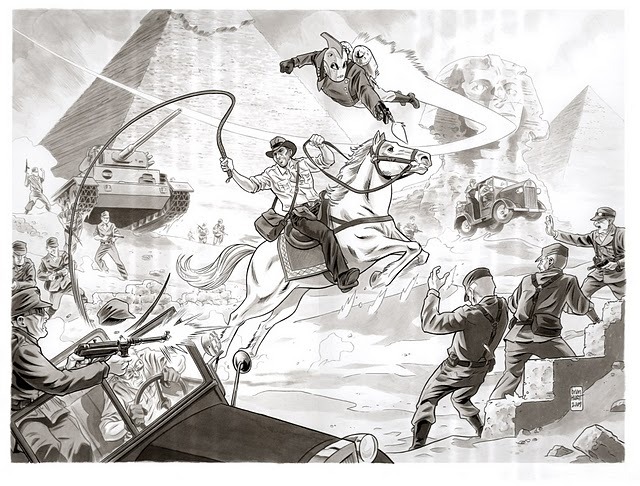
Adventurous like this!
 But the series will also be pulp in form, not just content. 

Pulp magazines were regular, serialised storytelling. That was its ‘thing’. People could expect the next instalment of their favourite hero because that expectation was a key attraction of the medium. What people don’t realise when reading classic pulp stories is that this penchant for being the ‘monarch of serialised storytelling’ was a crown the pulp magazines lost in the 50s and 60s. A crown that was taken by television. Pulps went underground but much of the best work in serialised storytelling from that point onwards was done by television writers, cranking out the adventures of your favourite characters on the same time, same channel every week.
Say this isn't pulp and I'll fight ya...
 In this way, I want Tommy’s adventures to be serialised. Properly serialised. So instead of looking to film or other successful novel series I want to look to television and the way it has perfected serialised storytelling. I want a regular cast of characters. I want a full story with each ‘episode’.  I want it to be accessible to everyone. But I also want an overarching story that stretches across the whole series. I want the series to be about characters plural, not just one individual, and I want them to each have their B and C plots, just like in my favourite television series. I want guest characters each episode and new threats to the status quo and, above all, I want to be able to look forward to the next episode so I can spend more time with these characters I’ve come to love. That to me is the perfect television experience, so that is what I will be attempting to write with Tommy Thunder – the greatest adventure television series you’ve ever read.
This, but never cancelled.
 And I’ll be doing it with an unlimited special effects and stunt choreography budget. Yay!!!

Pulp was also cheap, punchy, and perhaps worst of all, released on a monthly schedule. Now cheap is fairly easy to provide – Tommy’s focus will probably be e-reading with print on demand for people who like the tree-editions – but the ‘monthly schedule’ bit is perhaps where things get a little tricky for me the writer. Writing a full story on a monthly basis, while still earning enough money to feed myself, is not easy. So maybe ‘monthly’ is out of the question. But my hope is that by the time I get round to releasing the first set of stories I’ll be able to write at least one full Tommy adventure every three months with a goal to whittle that down to one every two.

That’s the plan, anyway.

The Tommy Thunder series is going to be an experiment, an attempt to write a story out of time, but written in what I hope is a very contemporary way. If I do my job right it should be a whole lot of fun and I can’t wait to edit and finish the first several stories so I can finally see what other people think. But sadly these things don’t edit themselves :-(

Next Pulp Manifesto I may get stuck into one of my favourite topics – adventure writing. Adventure writing, how it does and does not relate to action writing, and why they don’t make adventure stories like they used to. Stay tuned...

Saturday, 9 February 2013

Pulp Manifesto: What is Pulp?


That’s the question people always ask me: “What is pulp?” So for my first Pulp: Manifesto article I’m going to answer that very important question. Or at the very least tell you what ‘pulp’ means to me.

First up... it has nothing to do with that film by Tarantino. Nothing. Nothing at all.
This has nothing to do with pulp fiction writing. Sorry to disappoint.
 Now that we’ve got that out of the way...

The not-so-sexy answer to the question “What is pulp?” is that ‘pulp fiction’ is a production method for prose fiction that has sort of fallen out of favour over the last five to six decades. It’s actually the forerunner to many of the Western world’s most popular genres and storytelling mediums from the Hollywood blockbusters we watch at the cinema through to the comic books we read, or any form of sci-fi or action/adventure television that has somehow escaped cancellation. Even your Mills and Boon collection can trace its lineage straight back to this noble, yet forgotten genre. Pulp was there at the start but most people have never really been exposed to the source.
Yep, this be pulp. In all its 'horror'.
 The golden age of the pulp magazines was back in the 20s, 30s and 40s ie before television took over the family home. Back then, as literacy rates went through the roof, for the first time everyday people wanted to read stories and read them en masse. The more the better. But they didn’t enjoy, or couldn’t afford, those dusty hard-backed novels that the lar-dee-dah rich people read. For the first time the working-class were flexing their popular culture muscles and some entrepreneurs clicked to the fact that something new was needed to fill the need.
A dime novel cover, the pulp magazine's forerunner.
 So what did they do? The early magazine entrepreneurs took the older-style dime magazines, the sort that published serialised excerpts of stories by Charles Dickens et al, and jazzed them up for the new Jazz Age. They slapped a bright and thrilling cover on the front, started publishing multiple magazines that collected popular genre stories together, printed these magazines on the cheapest paper possible to keep the price reasonable (wood-pulp paper, hence ‘pulp’ magazines), then they sold these magazines at your local corner newspaper stand where everyone could find them. Voila! Affordable entertainment for the masses on a monthly basis.
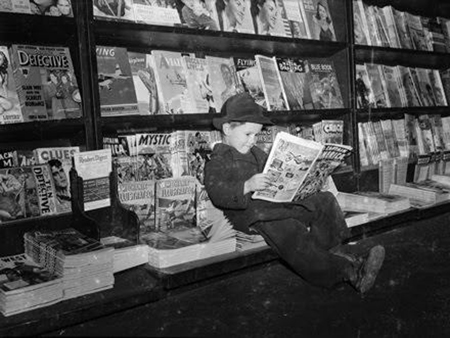
"Just readin' me magazines..."
 The writers of these magazines didn’t worry about literary worth. They didn’t worry about innovations in the art of storytelling. Or trying to add to the Western canon. Pulp writers just sat down at a typewriter and belted out stories that normal people would want to read. And the field took off. Month by month new magazines helped people escape their factory or secretarial work by taking them to new planets, showing how extraordinary citizens vanquished extraordinary bad guys, or revealed how the quiet girl finally got the cute beau from across the road she always pined for. It was all about entertainment and not much else.

People loved it.

Over time some characters became huge. They were so big they got their own magazines all to themselves. Names like Doc Savage, The Shadow and John Carter of Mars became household names. New-fangled genres started up – like those bizarre ‘scientific fiction’ stories – and soon had multiple magazines and devotees. The characters became so popular they were co-opted by Hollywood in movie serials or even a few of the A-features. They even spawned new storytelling mediums like graphic pulps, what we now call ‘comic books’. All these things and more began during that intense period spanning the first half of the 20th century and most of the genres and characters we still read and watch today trace their DNA straight back to the characters and stories of this fertile period of writing and reading.
You may not know this bloke, but many of your heroes are cheap knock-offs of him.
 The pulp magazines eventually died-out post-World War 2. Paper rationing during the War took its toll on profits and then television became the new preferred method of consuming serialised stories. There was no longer a need for magazines that provided cheap entertainment for the masses. Not when you could afford a television or buy those cheap paper-back novels that were now being made. The time of the pulp magazine was past and most of the energy and creativity of the industry migrated over to television to make Cold War Spy-Fi shows or Westerns.
Dime Novel > Pulp Magazine > Spy-fi  TV > Bond, James Bond.
 But the spirit of pulp has never died as it lives on in pretty much every genre-related field of entertainment known to pop culture. And, with the rise of the internet age and, more importantly, the e-reader, a new renaissance has occurred in the field and pulp fiction has become the inspiration for new stories and new characters in the new digital age. Downloadable kilobytes have replaced wood pulp paper and Amazon has replaced the newspaper stand but there’s a growing number of people who want to tell stories in the style of the old pulp magazines. Cheap, fast-paced, genre-focused stories that unapologetically exist to entertain, released on a regular basis so readers can get more and more of what they want. All of this has been made possible by the e-publishing revolution and it has meant that pulp is yet again alive and kicking.
And for some bizarre reason I’ve been caught up in it all...
"How did I get here?!?"
 So that’s a brief overview of pulp, with an even briefer flyover regarding the new satus quo of the field. A very short overview. But stay tuned next week. Next week I’ll go a little deeper and try to explain why I have chosen to write the Aether Age stories in the style of the pulps as well as the rewards, challenges and quirks of the genre and how they relate to Tommy Thunder. 

For all that and more, stay tuned...