Showing posts with label Tommy Thunder. Show all posts

Saturday, 13 April 2013

Pulp Manifesto - Crimson Skies and fan fiction gone horribly wrong/right.


Thought I’d talk about one of the major inspirations for Tommy Thunder this week on Pulp Manifesto. For those with a passing knowledge of the source material you’ll have a much better understanding of the sort of world the Aether Age is, while other people might be interested in my sordid tale of fan fiction gone horribly wrong/right.

Our journey starts with a little miniatures table top wargame called… Crimson Skies.


For those not in the know, the Crimson Skies world is a setting developed for a tabletop wargame, but is probably better known as a popular computer game that launched with the first X-Box. The tabletop game revolved around air combat set in an alternate universe 1930s setting where zeppelins dominated the sky and whacky planes with strong Art Deco styling either protected or raided said airships with swashbuckling audacity. The X-Box game followed suit with caper-filled air adventures that took you from Hawaii to New York as you followed the exploits of a daring squadron intent on… doing adventurous things.

In terms of pure Dieselpunk style the game is one of the best examples of a self contained Dieselpunk world. And, while the games are no longer being made, what material was produced still serves as many an innocent’s gateway drug to the world of Dieselpunk. More than a few people who received this dose of distilled Dieslpunky goodness have been left hankering for more.

I was one of these un/fortunates. I can’t remember all the details but at some stage during my sordid wargaming past I stumbled across some images of this crazy new world and its completely different take on fantasy or sci-fi or whatever it was. I didn’t know what genre it was and I never actually got a good look at the game itself (tabletop or X-Box) but I saw two things that immediately had me hooked and fantasising about my own adventures in this crazy new world.

The first thing I saw was the retrotech planes. Have you seen them? Here are some examples:


I LOVED the whackiness of these designs. My first exposure to the world was the miniatures and although I was never able to buy any myself I immediately fell in love with the idea of retroteching past eras. And can you smell the adventure? Nothing says adventurous swashbuckling like a push prop, Art deco-styled, pre-jet fighter plane. Nothing! These things dug deep down into my psyche to where that ‘Indiana Jones’ button was and started banging away saying ‘Here! Here! We’ve found something else that’s exactly like this! But with planes!’

The second thing I found – the thing that had me hooked for life – was this image:


 That there is a beautiful thing. It’s a map. Of a balkanised America. A map that provokes adventure and imagination and possibility. And not a single dwarf or elf to be seen anywhere. The minute I saw that thing my imagination was never able to let go of that obscure little world I had glimpsed but never directly experienced myself.

So I imaginated. A lot. As I am want to do. I daydreamed about a world in which I could suit up my whacky fighter plane, deck out a zeppelin and take to the skies in a deadly dance to the death with other similar fighter pilots. A world full of jazz and that cool 1930s styling (I had no idea what Art Deco was, but I liked it). A world of Indiana Jones style hijinks but with the added awesomeness of planes. A world of distinct characters and groups clashing in a world of fun instead of the usual gritty, serious and repetitive worlds that I kept encountering elsewhere in my wargaming and reading wanderings.

Fast forward several years and my Crimson Skies imaginating had joined the catalogue of other alternate worlds sequestered away in the back of my brain archives – there but lying dormant. Every now and then I would take the world out and play around with it, maybe scratch out some ideas or pipedream about being allowed to write a novel or something set in that world, but that’s all it was – pipedreaming. I even went so far as to start writing a comic. It was more an experiment in how to convey air combat in panels (the bane of all air comics – it’s really hard to do) with a Crimson Skies background but it worked really well, giving me more heartbreaking confirmation that I was on to something, but something that breached someone elses copyright. So  I put it back in the imagination archives and got on with my first novel, a novel set in a fantasy world with no magic (yep, I’m one of those people who can never do things the ‘normal’ way).

Then two things happened. First, I ran into some problems with my novel. I hit a wall and discovered that I’m a super detailed planner when it comes to writing. I couldn’t pants a plot to save myself. And I was pantsing my way to a standstill. My solution was to break the story down into smaller sections, a technique I’d been looking at with my newfound interest in old-school pulp writing and movie serials. But then I realised that, structurally speaking, I would be changing the novel and that if I was going to continue doing so I’d need to get more practise. Probably on other stories that were pulped from the beginning. So I sat down and scribbled out ideas for three different pulpy series that I could experiment with. My Crimson Skies idea was one of these ideas and the pulpiest of the lot.

The second thing I did was have a look around for Crimson Skies stuff now that I had this thing called the internet. It had been so long since I first discovered the idea that I wondered if there had been anything else written or wether a new game was coming out etc etc. What I found was a website where they recorded people playing the game so you could watch how each of the levels played out…

You know that thing where your memories of something are cruelly and brutally shanked when you actually go back and see it again as an adult?

Yeah. That.

The Crimson Skies I imagined wasn’t the Crimson Skies that actually existed out there in the real world. It wasn’t bad (it was still a lot of fun) and, objectively speaking, on the surface it was everything I remembered. But the overall effect I had created in my mind was… completely different.

It turns out the Crimson Skies game doesn’t take itself seriously. In many ways it’s actually a parody of the era. Is that a bad thing? No. The way in which it gently parodies itself is charming in its own way. But how are you supposed to take a story seriously if the characters are just caricatures? More importantly, how are you supposed to get your ‘punk on?

And it turns out that the plane designs weren’t original either. They were all based on real World War 2 X-plane designs, experimental planes that were never put into production because they never made the grade. For some reason seeing real world photographs of these machines hoovered away a lot of the romantic awe I had built up in my mind for the world’s originality. Turns out it wasn’t as original as I thought. Turns out it was based on a whole lot of other stuf that, to be honest, I wasn’t that into.

The Henschel Hs P75.

The Curtis Wright XP-55 Ascender.

The Sacks AS-6.

It also meant that the technology of the game included all sorts of post-World War 2 tech like guided missiles, jet engines on every plane and planes loaded down with an absurd number of machine guns. I knew that this was all for the game and simplifying it for more fun but it made me brutally aware that I wanted to scale the tech backwards, not forwards into the Cold-War era. But that’s exactly where Crimson Skies technology was headed – forwards.

And, weirdest of all, I just couldn’t accept the idea that the zeppelins – the very basis of this alternate world – were able to exist the way they did. Here they were laden down with armour and machine guns and planes, all without nary an explanation as to how they achieved the extra lift required. I was watching a world in which jet-enabled push prop aircraft were launching into battle with wings full of guided rockets but I couldn’t accept the fact that they were launched from a standard sized zeppelin with a Tardis-esque cargo bay full of armoured fighters.

I know I’m weird. But it’s the sort of weird I need to harness in order to write. And my weird was just not gelling with this particular scientific leap.

This then led me on a witch hunt through the alternate history aspects of the Crimson Skies universe at which point I started finding more things I didn’t like. I was now mercilessly tearing holes in the thing that I thought I loved. I was spurned, I was hurt and I was in shock. That thing that I based my fan fiction daydreaming on was not what I thought it was at all. What I was writing was almost in another universe completely…

It was at that time that I started to wonder if I was infringing copyright after all. Maybe I was actually writing my own thing altogether.

Some soul searching and I started going over all the things that I was doing differently to Crimson Skies. I wanted biplanes and trideckers, not guided rockets and jetplanes. That meant a 1920s setting instead of 1930s. I also didn’t know enough about American history to see how that many different groups could spread across the map in a realistic manner and rejected the map as unfeasible. In fact, while I was at it, history would suggest a different fracturing and for completely different reasons. So that was different in my version. And that problem with the zeppelins… that would take a little bit of sci-fi to fix with the addition of another lifting gas, what I would call ‘aether’. And if there was one sci-fi aspect then that would mean I could go super pulpy and start adding  <…spoiler redaction…>!

In the end, while the heritage is clear to those who know where to look, the tone and focus of the Aether Age world has ended up very different to that of Crimson Skies. Most similar is the balkanisation of a post World War 1 America with obvious things like the various power centres of the dissolved United States being similar in their broad sweeps even if they’ve been simplified and changed to some degree (After all, it doesn’t matter what alternate universe you  create, Texas will always be Texas. It’s a rule of the multiverse). But the earlier setting, the presence of aether and other unique sci fi additions, the different alternate history background and the stronger focus on non-aerial material gives The Aether Age a very different destination to all this 1920s American balkanisation.

Thus, thanks to Crimson Skies, Tommy Thunder has been born. And with him a world of aeronautical swashbuckling and pulpy madness, set in a balkanised America where anything pulpy is possible. It started with a Crimson Skies obsession built upon insufficient information. It has become a series of books I hope I can write for many decades to come. And I hope you can all come along for the ride with me.

In the future I’ll reveal some more of the inspirations behind Tommy Thunder and the world of The Aether Age but in the meantime, if you were one of those un/fortunates  to get hooked on Dieselpunk or pulp via Crimson Skies I’d love to hear from you. Don’t be afraid to leave a comment below :)

Happy flying,

Grant.

Saturday, 6 April 2013

My first writer's update.

Hi. My name is Grant. And I'm a writer...

Okay, so I've been avoiding this. Avoiding the need to post a writer's update for a while now. It's not that I have something against writer's updates - far from it, they're the staple of most writer blogs and the reason people show up at writer blogsites - it's just that once I do one update on where I'm up to with my writing then I'm gonna have to keep doing them. For the rest of my writing career.

So the pressure is on.

Actually, I was hoping to delay giving writer updates for a while because I didn't plan on blogging until I had most of my writing ducks in a row ie when I actually had something to write about ie when I had things like book covers etc to show. But then the Dieselpunk Showcase opportunity came along and that wrecked everything. I had to dash out there and set up a blog, and apply for one of those GoodReads author accounts, and sign up to Amazon... A whole lot of work. But it did get me out there in internet writer land and for that I'm grateful. And I have a GoodReads author page now. Which is pretty cool :)

And now there are people googling my name. Which means... the pressure is back on. <disconcerted smiley>

Speaking of the Dieselpunk Showcase: we recently passed 3,500 downloads. Which is pretty good for an indie. It's a free book so a percentage of those downloads will be people who wont get round to reading it (they're called hoarders because they like to download stuff for the sake of downloading stuff - apparently it's a thing) but if even half of those copies are read then the project has been a success for our intrepid little band of authors. And with a steady trickle of downloads still coming via Amazon and more reviews and ratings showing up on GoodReads all the time, etc it can only get more successful.

If you have arrived here after reading the Showcase then, yeah, I'm the bloke who wrote the first story in the anthology, That Sort of World. Hope you enjoyed it. I've only got one more story on the web at the moment, a story posted over at Alternatehistoryweeklyupdate.blogspot.com called The More Things Change. It's another free short story set in the Aether Age universe, this time in a little gambling town called Las Vegas. It was a complicated little story for such a small word limit but I'm pretty happy with how it turned out.

Which brings me to the important stuff. Tommy Thunder and the Aether Age stuff.

If anyone's interested there is plenty of Tommy Thunder and Aether Age writing in the pipeline, all of which should be released some time this year. At the moment I am working on four separate books that I hope to release all at once some time in the next three months. (The schedule is up in the air until I finally do get around to organising covers and braving the gauntlet of paperwork that is the American IRS application form).

Yeah, that's right. Four different books to be released at once. With several more to follow.

Why four? The plan is to release enough story to get people interested in hanging around for the next issues and I figure if people like the first book then they'll want to read the next book but if it isn't released they may wander off and forget about me :( So I'm going to release four books and people who like my writing will be able to buy as many of them as they like and get properly immersed in the series etc.

Of the four books, three will be Tommy Thunder, Scourge of the Skypirate books (#1-#3) and the other will be Tales of the Aether Age volume #1 which is a book full of short stories similar to That Sort of World set in the Aether Age universe but not directly linked to Tommy's Carribean adventures.

And the names of these books (at this minute, which may change before publication)?

Tommy Thunder in: The Black Vixen of Deadman's Island & The Mystery of the Silent Zephyr.
Tommy Thunder in: The Race for the White Fedora.
Tommy Thunder in: The Big Fight at The Crater.

and...

And I'll keep the names of the Aether Age short stories for another post. I'll also have another post soon about how far I am along the path with each individual book etc etc.

So, if you've just wandered in - welcome to my quirky corner of the interwebs. If you've visited a few times then feel free to ask any questions you have or give any feedback on the website or my writing and I hope you stick around to enjoy the bizarre mix of Dieselpunk, pulp, alt history and other vaguely associated things this blog is turning into.

Cheers,

Grant. The bloke who writes the stuff.

Friday, 15 February 2013

Pulp Manifesto: The Pulpiness of Tommy Thunder.


Last Pulp Manifesto I explained what ‘pulp’ was, so this time I’m going to explain what the Tommy Thunder series is and how (I hope) it will be influenced by pulp.

For those of you who have just joined us, pulp stories were written for magazines published on a monthly basis with a strong emphasis on genre fiction and entertainment value. They were cheap entertainment anyone could read on a regular basis and skewed towards the fantastic and the emotionally riveting. They were pulp.

And I want Tommy Thunder to be the same way. The goal of the Tommy Thunder series is to be as adventurous as humanly possible on a regular basis. If I had a mission status, that’s what it would be: ‘as adventurous as humanly possible on a regular basis’. I want to explore worlds and I want to have fun exploring them and I want to be completely unapologetic about that goal. Tommy Thunder is about adventure, set in the golden age of adventure, following a character whose political affiliation is ‘adventure’. That’s what the series is, that’s who Tommy is, but it’s an adventure that just happens to be served up via biplanes, zeppelins and gangsters because that sort of stuff just floats my boat.
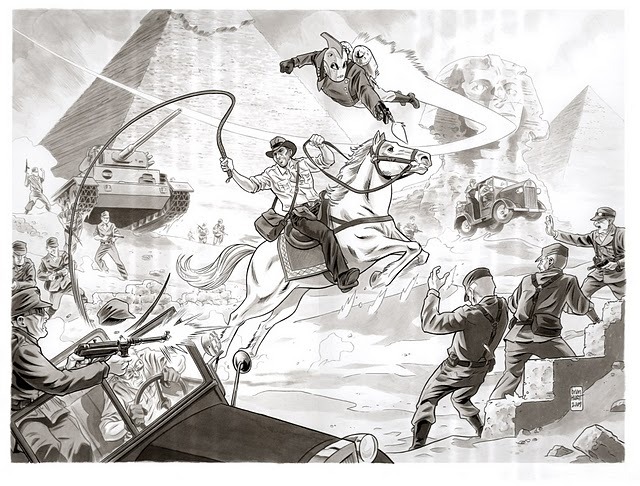
Adventurous like this!
 But the series will also be pulp in form, not just content. 

Pulp magazines were regular, serialised storytelling. That was its ‘thing’. People could expect the next instalment of their favourite hero because that expectation was a key attraction of the medium. What people don’t realise when reading classic pulp stories is that this penchant for being the ‘monarch of serialised storytelling’ was a crown the pulp magazines lost in the 50s and 60s. A crown that was taken by television. Pulps went underground but much of the best work in serialised storytelling from that point onwards was done by television writers, cranking out the adventures of your favourite characters on the same time, same channel every week.
Say this isn't pulp and I'll fight ya...
 In this way, I want Tommy’s adventures to be serialised. Properly serialised. So instead of looking to film or other successful novel series I want to look to television and the way it has perfected serialised storytelling. I want a regular cast of characters. I want a full story with each ‘episode’.  I want it to be accessible to everyone. But I also want an overarching story that stretches across the whole series. I want the series to be about characters plural, not just one individual, and I want them to each have their B and C plots, just like in my favourite television series. I want guest characters each episode and new threats to the status quo and, above all, I want to be able to look forward to the next episode so I can spend more time with these characters I’ve come to love. That to me is the perfect television experience, so that is what I will be attempting to write with Tommy Thunder – the greatest adventure television series you’ve ever read.
This, but never cancelled.
 And I’ll be doing it with an unlimited special effects and stunt choreography budget. Yay!!!

Pulp was also cheap, punchy, and perhaps worst of all, released on a monthly schedule. Now cheap is fairly easy to provide – Tommy’s focus will probably be e-reading with print on demand for people who like the tree-editions – but the ‘monthly schedule’ bit is perhaps where things get a little tricky for me the writer. Writing a full story on a monthly basis, while still earning enough money to feed myself, is not easy. So maybe ‘monthly’ is out of the question. But my hope is that by the time I get round to releasing the first set of stories I’ll be able to write at least one full Tommy adventure every three months with a goal to whittle that down to one every two.

That’s the plan, anyway.

The Tommy Thunder series is going to be an experiment, an attempt to write a story out of time, but written in what I hope is a very contemporary way. If I do my job right it should be a whole lot of fun and I can’t wait to edit and finish the first several stories so I can finally see what other people think. But sadly these things don’t edit themselves :-(

Next Pulp Manifesto I may get stuck into one of my favourite topics – adventure writing. Adventure writing, how it does and does not relate to action writing, and why they don’t make adventure stories like they used to. Stay tuned...

Saturday, 9 February 2013

Pulp Manifesto: What is Pulp?


That’s the question people always ask me: “What is pulp?” So for my first Pulp: Manifesto article I’m going to answer that very important question. Or at the very least tell you what ‘pulp’ means to me.

First up... it has nothing to do with that film by Tarantino. Nothing. Nothing at all.
This has nothing to do with pulp fiction writing. Sorry to disappoint.
 Now that we’ve got that out of the way...

The not-so-sexy answer to the question “What is pulp?” is that ‘pulp fiction’ is a production method for prose fiction that has sort of fallen out of favour over the last five to six decades. It’s actually the forerunner to many of the Western world’s most popular genres and storytelling mediums from the Hollywood blockbusters we watch at the cinema through to the comic books we read, or any form of sci-fi or action/adventure television that has somehow escaped cancellation. Even your Mills and Boon collection can trace its lineage straight back to this noble, yet forgotten genre. Pulp was there at the start but most people have never really been exposed to the source.
Yep, this be pulp. In all its 'horror'.
 The golden age of the pulp magazines was back in the 20s, 30s and 40s ie before television took over the family home. Back then, as literacy rates went through the roof, for the first time everyday people wanted to read stories and read them en masse. The more the better. But they didn’t enjoy, or couldn’t afford, those dusty hard-backed novels that the lar-dee-dah rich people read. For the first time the working-class were flexing their popular culture muscles and some entrepreneurs clicked to the fact that something new was needed to fill the need.
A dime novel cover, the pulp magazine's forerunner.
 So what did they do? The early magazine entrepreneurs took the older-style dime magazines, the sort that published serialised excerpts of stories by Charles Dickens et al, and jazzed them up for the new Jazz Age. They slapped a bright and thrilling cover on the front, started publishing multiple magazines that collected popular genre stories together, printed these magazines on the cheapest paper possible to keep the price reasonable (wood-pulp paper, hence ‘pulp’ magazines), then they sold these magazines at your local corner newspaper stand where everyone could find them. Voila! Affordable entertainment for the masses on a monthly basis.
"Just readin' me magazines..."
 The writers of these magazines didn’t worry about literary worth. They didn’t worry about innovations in the art of storytelling. Or trying to add to the Western canon. Pulp writers just sat down at a typewriter and belted out stories that normal people would want to read. And the field took off. Month by month new magazines helped people escape their factory or secretarial work by taking them to new planets, showing how extraordinary citizens vanquished extraordinary bad guys, or revealed how the quiet girl finally got the cute beau from across the road she always pined for. It was all about entertainment and not much else.

People loved it.

Over time some characters became huge. They were so big they got their own magazines all to themselves. Names like Doc Savage, The Shadow and John Carter of Mars became household names. New-fangled genres started up – like those bizarre ‘scientific fiction’ stories – and soon had multiple magazines and devotees. The characters became so popular they were co-opted by Hollywood in movie serials or even a few of the A-features. They even spawned new storytelling mediums like graphic pulps, what we now call ‘comic books’. All these things and more began during that intense period spanning the first half of the 20th century and most of the genres and characters we still read and watch today trace their DNA straight back to the characters and stories of this fertile period of writing and reading.
You may not know this bloke, but many of your heroes are cheap knock-offs of him.
 The pulp magazines eventually died-out post-World War 2. Paper rationing during the War took its toll on profits and then television became the new preferred method of consuming serialised stories. There was no longer a need for magazines that provided cheap entertainment for the masses. Not when you could afford a television or buy those cheap paper-back novels that were now being made. The time of the pulp magazine was past and most of the energy and creativity of the industry migrated over to television to make Cold War Spy-Fi shows or Westerns.
Dime Novel > Pulp Magazine > Spy-fi  TV > Bond, James Bond.
 But the spirit of pulp has never died as it lives on in pretty much every genre-related field of entertainment known to pop culture. And, with the rise of the internet age and, more importantly, the e-reader, a new renaissance has occurred in the field and pulp fiction has become the inspiration for new stories and new characters in the new digital age. Downloadable kilobytes have replaced wood pulp paper and Amazon has replaced the newspaper stand but there’s a growing number of people who want to tell stories in the style of the old pulp magazines. Cheap, fast-paced, genre-focused stories that unapologetically exist to entertain, released on a regular basis so readers can get more and more of what they want. All of this has been made possible by the e-publishing revolution and it has meant that pulp is yet again alive and kicking.
And for some bizarre reason I’ve been caught up in it all...
"How did I get here?!?"
 So that’s a brief overview of pulp, with an even briefer flyover regarding the new satus quo of the field. A very short overview. But stay tuned next week. Next week I’ll go a little deeper and try to explain why I have chosen to write the Aether Age stories in the style of the pulps as well as the rewards, challenges and quirks of the genre and how they relate to Tommy Thunder. 

For all that and more, stay tuned...